
GPU Buying Guide 2026: Best Graphics Card at Every Budget
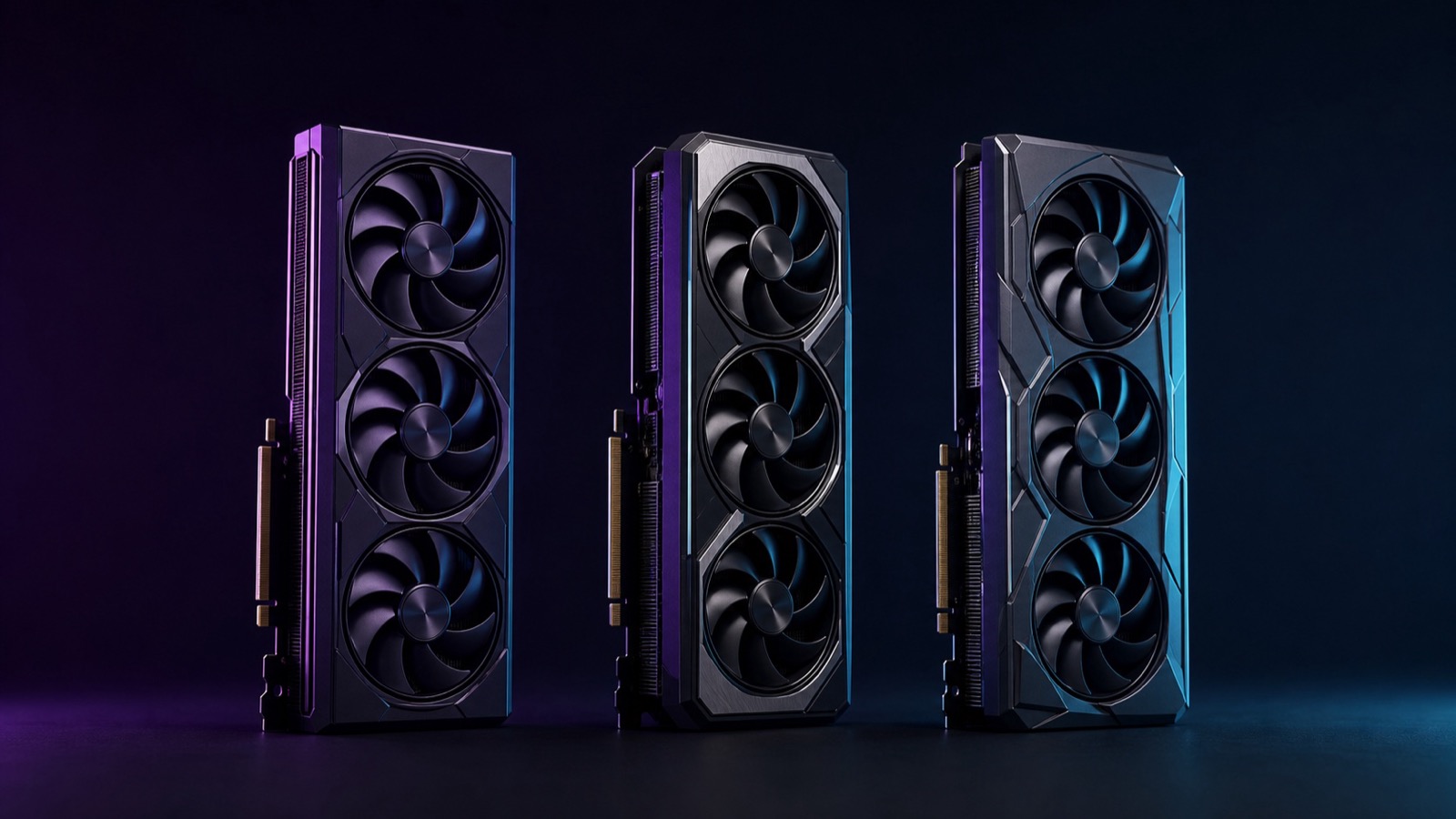
Every recommendation below comes off our own test bench, not a launch-day slide deck. We run each card through the same ten-game suite at 1080p, 1440p and 4K — three repeatable runs per title, medians reported, driver versions noted in our internal log (current round: NVIDIA 580.xx WHQL, Adrenalin 26.5.1). All prices are USD street prices as of July 2026, and they fluctuate weekly; if a card is more than 10% above the figure quoted here, it stops being a good buy and you should reassess. No affiliate links, no store links — we don't care where you buy.
Entry tier (~$250): 1080p done right
Our pick: AMD Radeon RX 9060 XT 16 GB. At around $270 street it delivers a locked 60+ FPS at 1080p Ultra in everything we threw at it, and well over 100 FPS in esports titles. The 16 GB of VRAM is the reason to buy it over anything NVIDIA offers at this price — newer engines are already pushing past 8 GB at high texture settings, and we measured stutter in Hogwarts Legacy on the 8 GB cards that simply doesn't exist here. Rasterization is excellent; ray tracing is usable at Medium with FSR. Skip it only if you specifically need CUDA for creative work.
Alternative: NVIDIA RTX 5060 (~$250). About 8% faster in ray tracing with DLSS as the better upscaler, but the 8 GB VRAM buffer is already a ceiling in 2026's heaviest titles. Buy only if it's meaningfully cheaper than the 9060 XT.
Mainstream tier (~$400–500): the 1440p sweet spot
Our pick: NVIDIA RTX 5070 12 GB. Street price around $500 and the card most people should actually buy. It averages 90–110 FPS at 1440p Ultra in our suite with DLSS Quality, and it holds 60+ with ray tracing on High — the first price point where we'd call RT genuinely worth enabling. The 12 GB of VRAM is adequate today but is the card's one compromise; expect to nudge textures down in the most demanding titles by 2028. If you play at 1440p and want one card to last four years of sensible settings, this is it.
Alternative: AMD Radeon RX 9070 16 GB (~$480). Roughly 5% faster in pure raster, 16 GB of VRAM, and FSR 4 has closed most of the upscaling gap. Ray tracing still trails NVIDIA by 15–20%. The rational choice if you don't care about RT; the wrong one if you do.
High-end tier (~$700–900): 1440p maxed, 4K credible
Our pick: AMD Radeon RX 9070 XT 16 GB (~$650–700). The value surprise of this generation. It trades blows with cards that cost $150 more, averaging 120+ FPS at 1440p Ultra and a genuine 60–80 FPS at 4K with FSR Quality. 16 GB of VRAM means no texture compromises anywhere. Ray tracing at 1440p High is finally comfortable on Radeon. Skip only if path tracing or heavy RT workloads are your priority — that's still NVIDIA's home turf.
Alternative: NVIDIA RTX 5070 Ti 16 GB (~$800–850). 8–12% faster overall, clearly faster with RT enabled, and DLSS frame generation is the more mature implementation. It's the better card; whether it's $150 better depends on how much you care about ray tracing. At $850 street it's fairly priced; at $950 it isn't.
Enthusiast tier (~$1200+): no compromises
Our pick: NVIDIA RTX 5080 16 GB (~$1,100–1,200). Native 4K at 80–100 FPS in everything except path-traced showcases, where DLSS Quality closes the gap. Sixteen gigabytes of VRAM, excellent power efficiency for the performance, and the full RT feature set. It's the sane flagship — the card you buy when you want 4K to be boring. Our one complaint: at launch pricing it was poor value, and it's only become recommendable as street prices settled.
The halo option: RTX 5090 32 GB (~$2,000+ street). Roughly 25–30% faster than the 5080 and the only card that does path-traced 4K without flinching. It is also double the price for a third more performance, draws over 500 W, and needs a serious case and PSU. Buy it if money genuinely doesn't matter and you want the ceiling; everyone else is paying enthusiast tax.
| Model | Tier | VRAM | 1440p avg FPS (relative) | Verdict |
|---|---|---|---|---|
| RX 9060 XT | Entry · ~$270 | 16 GB | ~55% (1080p card) | Buy for 1080p Ultra |
| RTX 5060 | Entry · ~$250 | 8 GB | ~52% | Only if cheaper; VRAM-limited |
| RTX 5070 | Mainstream · ~$500 | 12 GB | 100% (baseline) | The default 1440p pick |
| RX 9070 | Mainstream · ~$480 | 16 GB | ~105% | Raster value king |
| RX 9070 XT | High-end · ~$680 | 16 GB | ~135% | Best high-end value |
| RTX 5070 Ti | High-end · ~$830 | 16 GB | ~145% | Best RT under $1,000 |
| RTX 5080 | Enthusiast · ~$1,150 | 16 GB | ~170% | The sane 4K flagship |
| RTX 5090 | Halo · ~$2,000+ | 32 GB | ~215% | The ceiling, at a price |
A word on the used market
Last-gen cards — the RTX 4070 Super, RX 7900 XT — still turn up at tempting prices, and a 4070 Super under $400 is a legitimate buy. But check three things: fan condition and thermal paste age (mining-era stock ran hot for years), a purchase receipt for warranty transfer, and price per frame against current cards. A used card at 80% of a new card's price with no warranty is a bad trade, not a bargain. And never buy a used flagship with corrosion around the power connector — the 12VHPWR melting saga left a lot of damaged stock in circulation.
PSU requirements — check before you buy
The most common upgrade failure in our reader mail is a great GPU choking on a weak or old power supply. Guidance from our bench measurements: RX 9060 XT / RTX 5060 — a quality 550 W unit is fine. RTX 5070 / RX 9070 class — 650 W. 9070 XT and 5070 Ti — 750 W, and the XT's transient spikes punish cheap units specifically. RTX 5080 — 850 W from a reputable line. RTX 5090 — 1000 W minimum, using the PSU's native 12V-2x6 cable, not an adapter daisy-chain. If your PSU is more than seven years old, replace it with the GPU; capacitors age.
When NOT to upgrade
Honestly: more often than the industry wants you to believe. Skip this generation if any of these apply. You're on a 3070 / 6700 XT or better and play at 1080p — our optimization guide will get you further than $500 will. Your actual problem is a CPU bottleneck — if GPU utilization sits under 85% in the games you play, a new card changes nothing. You're waiting on a monitor upgrade — buy the 1440p high-refresh display first, then the GPU to drive it. And if your current card holds 60 FPS at settings you find acceptable, the correct upgrade budget is zero.